
Search Michigan Court Dockets
Michigan court dockets are public records kept by circuit, district, and probate courts in each of the state's 83 counties. The Michigan Courts Case Search portal gives free online access to docket entries from all 57 circuit courts, the Court of Appeals, and the Supreme Court. You can search by name, case number, or attorney. Some courts have their own local tools as well. This guide covers how to find Michigan court dockets, what records are public, and where to go when you need certified copies or full case files.
Michigan Court Docket Overview
Michigan Court Docket System Overview
Michigan runs a unified court system called the One Court of Justice. It has four main levels. The Supreme Court sits at the top with seven justices. Below it is the Court of Appeals, which reviews lower court decisions. Trial courts make up the bulk of Michigan court docket activity. Circuit courts handle felony cases, civil matters over $25,000, and family law. District courts handle misdemeanors, civil cases up to $25,000, and small claims. Probate courts handle estates, guardianships, and mental health cases. Together, these courts generate the public docket records you can search online or request in person.
A court docket in Michigan is a running log of everything that happens in a case. The formal term is the Register of Actions (ROA). It shows the date of each event and what took place. Common entries include the first filing, service of process, motions, court orders, and hearing results. The ROA tells you the case number, the names of all parties, and the type of case. It does not include the full text of filed documents. Public access to Michigan court dockets is governed by MCR 8.119, which sets the rules for what courts must make available and what they may restrict.
Visit courts.michigan.gov for links to all Michigan courts, forms, and court rules across every level of the state system.
Michigan Court Dockets Online Search
The main online tool for Michigan court docket searches is the Michigan Courts Case Search, also called MiCOURT. It covers the Supreme Court, Court of Appeals, Court of Claims, and all 57 circuit courts statewide. The search is free. You can look up cases by party name, case number, attorney name, or case type. Results show party names, docket entries, case status, and hearing dates. You will not find document images through this system. Only the case index and docket history are shown online.
The Michigan Courts Case Search portal is the starting point for most public docket lookups. To run a name search, click "Advanced Search" and enter the party's name. The system checks all courts at once. Common names may return many results, so have a case number ready if you can. The portal states that results are not official court records and should not be used for background checks.
The Michigan Courts website at courts.michigan.gov is the official hub for all court resources statewide.
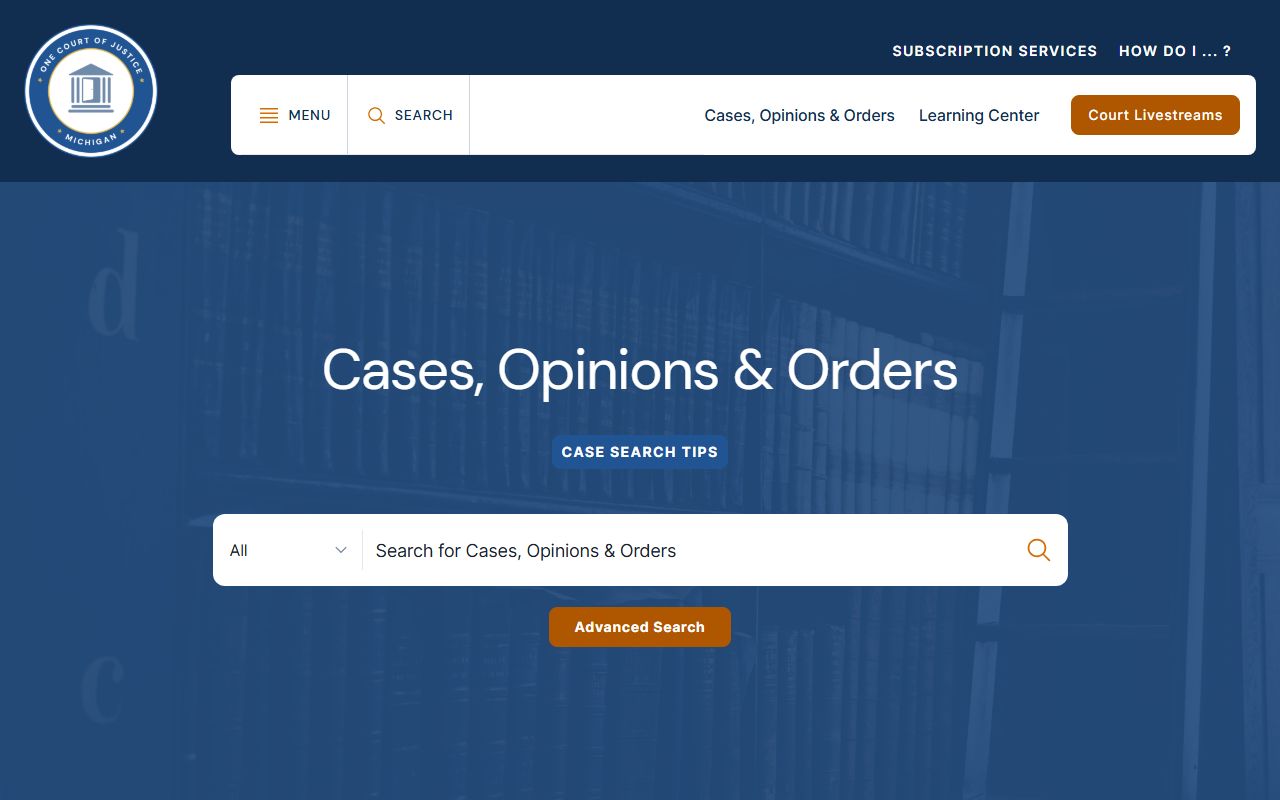
The case search portal is free to use and requires no login or registration to run basic docket searches.
Some Michigan courts have their own local search tools. Ingham County provides a detailed search for circuit and probate court records at courts.ingham.org. Criminal cases go back to 2000 and other cases to 1986. Huron County has its own clerk case search at apps.huroncountyclerk.com. Saginaw County uses an Odyssey portal at odysseycourtinformation.saginawcounty.com. Wayne County's Third Judicial Circuit offers the Odyssey Public Access (OPA) system with civil and criminal records going back to 1942. Otsego County's 87-A District Court has its own online docket lookup at lookup.circuit46.org with over 268,000 entries. Check with your county court if the statewide system does not return results.
What Michigan Court Dockets Show
Court dockets in Michigan cover many types of cases. Civil dockets cover lawsuits, contract disputes, personal injury cases, and business matters. Criminal dockets show charges, arraignments, bond terms, plea entries, and sentencing. Family dockets cover divorce, custody, child support, and paternity cases. Probate dockets handle estate administration, guardianship, and conservatorship matters. Each court type keeps its own docket, and the information available varies by case type.
A typical Michigan court docket entry shows the date, the name of the filing party or the court, and a short description of what happened. You might see entries like "Complaint Filed," "Answer to Complaint," "Motion for Summary Judgment," "Hearing Set," and "Order Entered." The docket is a timeline. It tells you the full sequence of events from the day the case was filed to when it closed. If a case is still active, you will see the most recent entry and any upcoming hearing dates.
Note: Document images are not available through the statewide MiCOURT system. Only case indexes and docket summaries appear online. You must go to the courthouse or submit a written request to get actual filed documents.
Michigan Court Docket Public Access Rules
Most Michigan court dockets are open to the public. Under MCR 8.119, courts must make case indexes and public records available for inspection. You do not need to be a party to a case to access public dockets. You do not need to give a reason for your request. The court cannot charge you just to look at public records, though copy fees apply when you want paper or electronic copies.
Not all dockets are public. MCR 3.705 bars online access to Personal Protection Order (PPO) cases. Cases under the Holmes Youthful Trainee Act (HYTA) are sealed and not accessible. Juvenile records under MCL 600.1750 are generally confidential. Drug charges disposed under MCL 333.7411 for first-time offenders do not appear in public online searches. Adoption records are sealed. Child protection cases are confidential. If you search and do not find a record, it may have been expunged, sealed, or the court may not yet have it in the online system.
Michigan's Clean Slate Law, passed in 2020, allows for automatic and petition-based expungement of many criminal records. As courts work through the process, some older docket entries may be removed from public access. Several counties have noted this affects their records going back seven or more years in some cases.
Court records in Michigan are generally NOT subject to the Freedom of Information Act (FOIA). The Michigan FOIA (Act 442 of 1976) applies to executive branch agencies, not courts. Access to court records is governed by court rules under MCR 8.119. You can read the FOIA law at legislature.mi.gov. MCR 8.119(H)(5) also requires courts to redact protected personal information, including Social Security numbers and financial account numbers, before giving you copies.
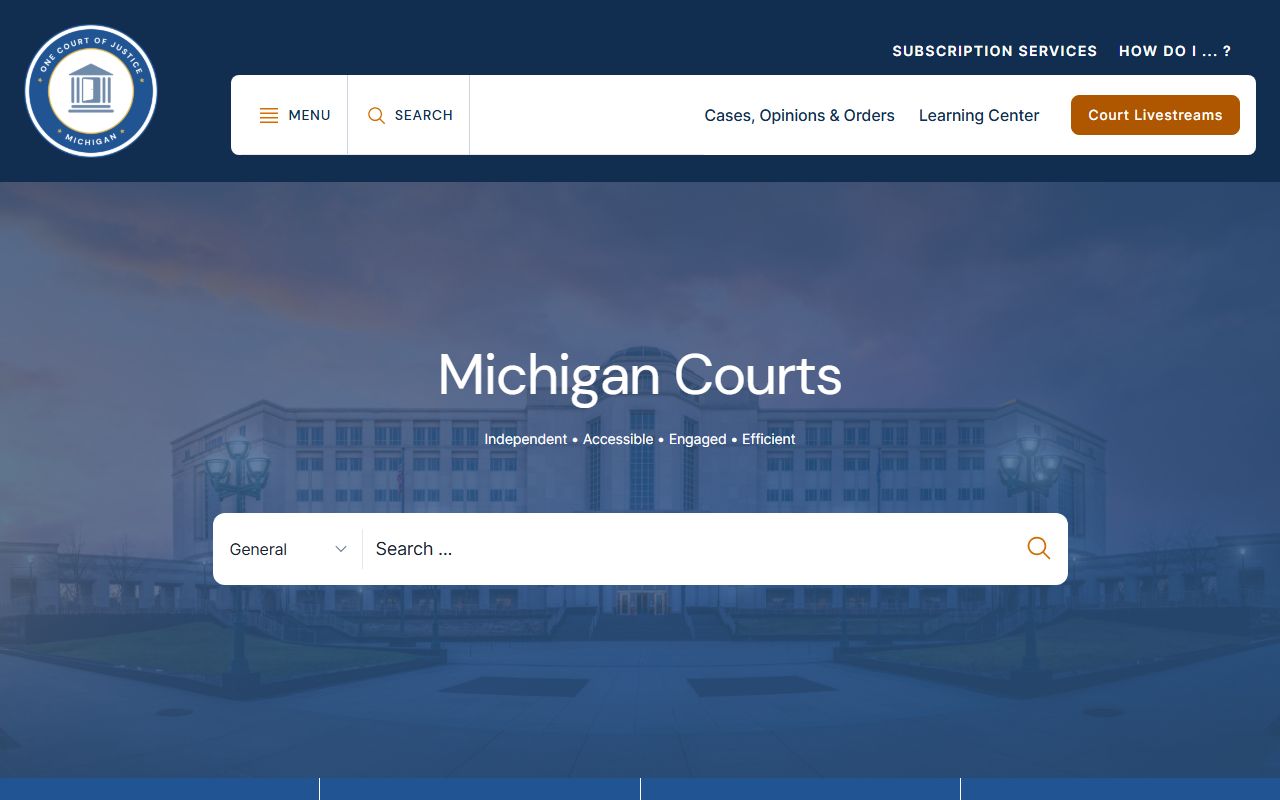
The Michigan Courts website is your best starting point for understanding public access rules and finding the right court for your search.
In-Person Michigan Court Docket Access
Every courthouse in Michigan provides public access terminals where you can search dockets at no charge. To get copies, staff at the clerk's window can assist. You typically need a case number or party name to start. Bring a valid photo ID. Some courts ask you to schedule an appointment for record requests, especially for older or archived cases. Call ahead to confirm the process before you visit.
Mail requests are accepted at most courts. Send a written request with the case number or party names, your contact information, and payment for copy fees. Standard copy fees run about $1 to $2 per page. Certified copies cost more. Eaton County, for example, charges $2 per page for regular copies and $10 for the first certified page plus $1 per additional page. Livingston County charges $1.50 per page with a $10 certification fee. St. Clair County offers an online document request for $15 per document plus a $5 processing fee. Include a self-addressed stamped envelope if you want documents returned by mail. Most courts accept check or money order; some do not accept credit cards.
Berrien County has two clerk locations: the main office at 811 Port Street in St. Joseph and a south office at 1205 N. Front Street in Niles. Family division files may be off-site there, so call ahead. Genesee County has seven district court divisions across the county, each maintaining its own docket. Research for older genealogical records at Houghton County costs $5 for a three-year search plus $1 for each additional year.
Michigan Court Forms and E-Filing
Michigan courts use MiFILE for electronic filing. Attorneys are required to e-file in most civil cases. Self-represented parties may e-file but are not required to do so in most courts. MiFILE also sends email alerts for updates on your case, including status changes and clerk actions. Visit mifile.courts.michigan.gov to set up an account or to check which courts participate in e-filing.
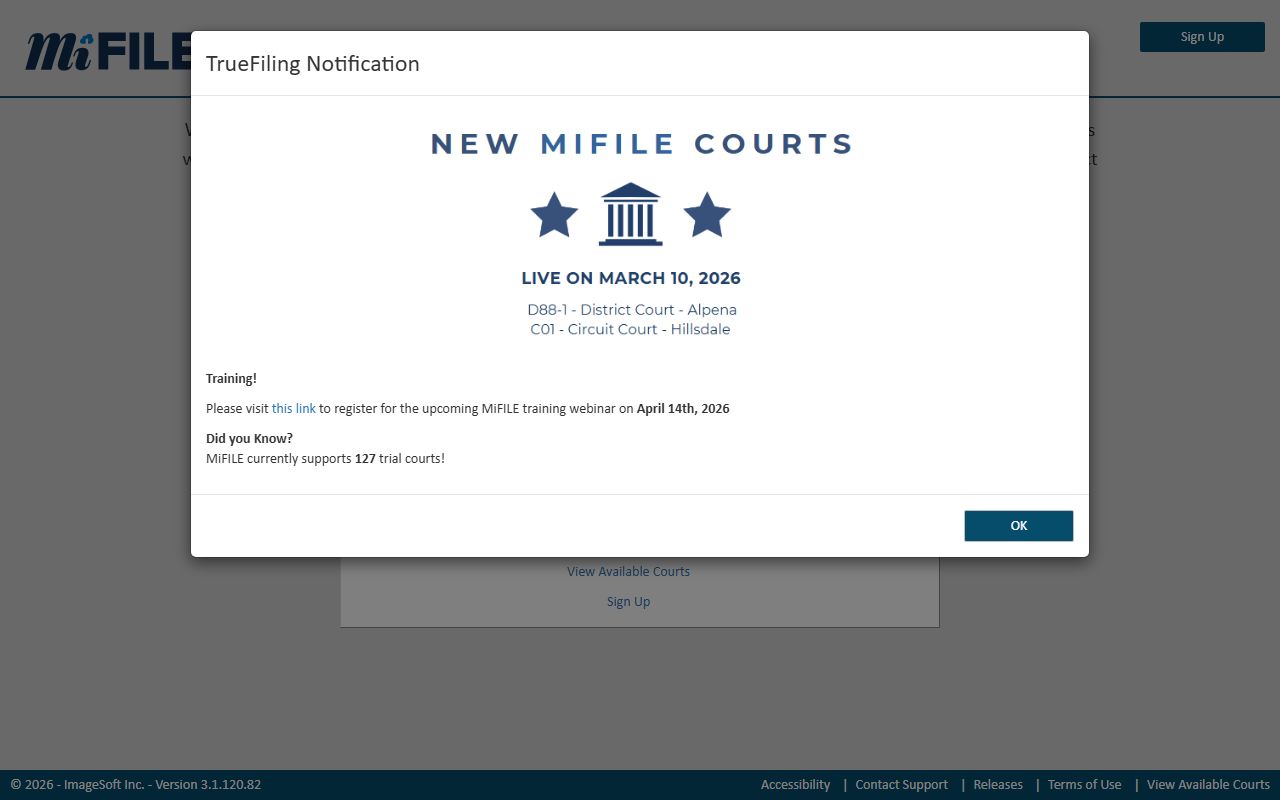
MiFILE notifies you by email when something new happens in your case, making it easier to stay on top of active matters.
Standard court forms known as SCAO forms are available free at courts.michigan.gov/SCAO-forms/. These cover civil, criminal, family, and probate matters. Fill them out and print them, or use MiFILE to submit them electronically in courts that accept e-filing. The 15th District Court in Ann Arbor requires e-filing for attorneys in civil cases as of July 2023. That court also ended fax filings for general civil cases as of April 2023. Many proceedings in Michigan now use Zoom for hearings, so check with your specific court for its current rules.
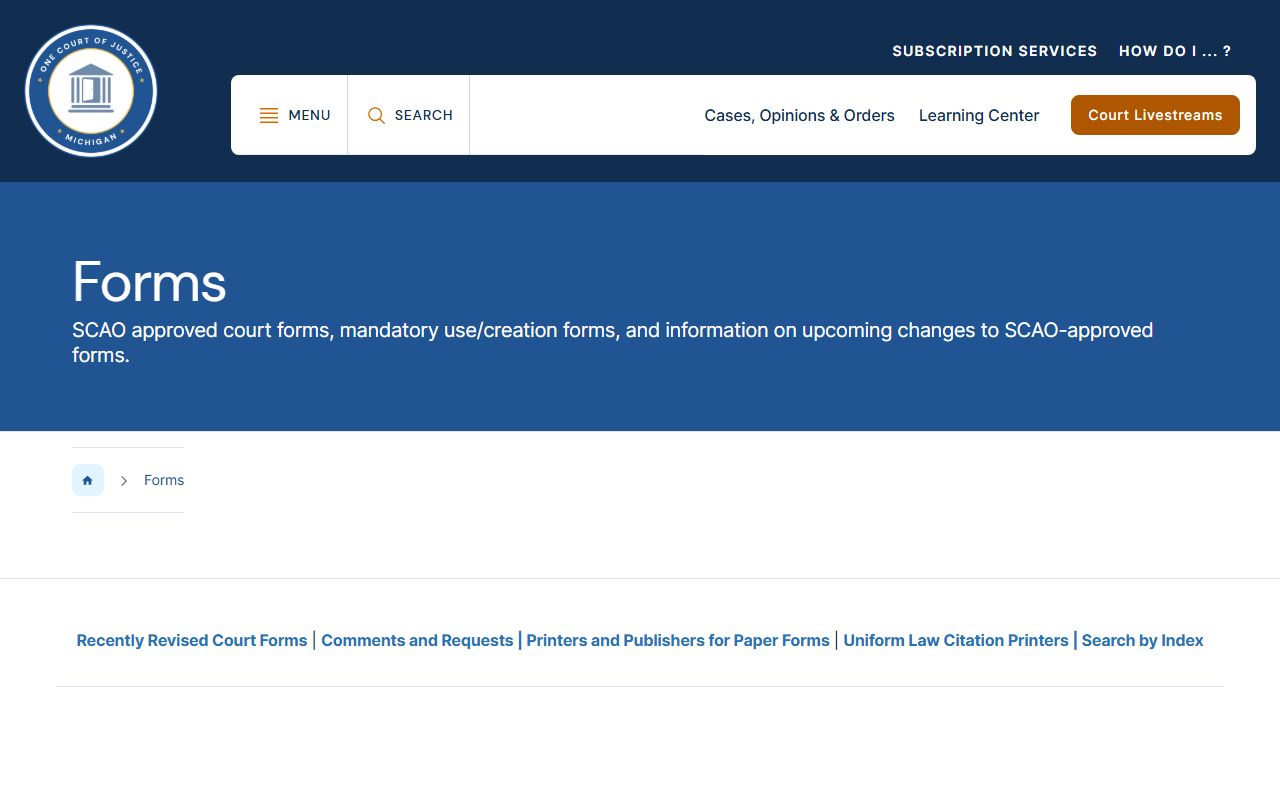
SCAO forms are updated regularly by the State Court Administrative Office. Always check the forms page for the latest version before submitting anything.
Special Court Dockets in Michigan
Michigan has several types of specialized court dockets. Under Public Act 333, circuit courts with three or more judges must maintain a dedicated Business Court docket. Cases involving business or commercial disputes go on this docket at the start or later if they qualify. Livingston County runs a Business Court docket. If you are searching for a business dispute, look in the circuit court for the county where the business operates or the contract was signed.
Treatment courts maintain their own dockets. These include drug courts, mental health courts, sobriety courts, and veterans' courts. Tuscola County runs both a Mental Health Court and a Sobriety Court. Dearborn's 19th District Court offers a Sobriety Court and a Veterans Treatment Court. Warren's 37th District Court has a Drug Court program. Access to treatment court dockets may be restricted depending on the program. Contact the court directly to ask about its records policies.
You can watch live and recorded Michigan court hearings online. The One Court of Justice Livestreams page has links to live and archived proceedings for the Supreme Court and participating lower courts.
Historical Michigan Court Docket Records
The Archives of Michigan holds older court records no longer kept at the courthouse. You can request historical Supreme Court and Court of Appeals case files through the archives. A general record search costs $15. Each Supreme Court case file costs $50, and Court of Appeals case files also cost $50 per file. Probate records run $40 each. Requests go to the Archives of Michigan, 702 W. Kalamazoo Street, P.O. Box 30740, Lansing, MI 48909. Call (517) 373-1408 or email archives@michigan.gov. Learn more at michigan.gov/archivesofmi.
County-level historical records vary widely. Alcona County has court records from 1869, though records before March 12, 1869 may be in Mackinac, Cheboygan, Alpena, or Iosco counties. Alger County goes back to 1885. Lenawee County records date to 1822. St. Joseph County holds circuit court records back to the 1830s. Keweenaw County records start in 1867. For genealogical research, the University of Michigan Law Library and Georgetown Law Library both have research guides for Michigan court records.
Court Dockets vs. Criminal Background Checks
Online court docket searches are NOT the right tool for criminal background checks. The Michigan Courts Case Search, local county portals, and similar tools are designed for looking up specific cases. They are not complete criminal history databases. Results may miss cases in courts that do not participate in the statewide system. They may also exclude records that were expunged or sealed.
For official criminal history checks in Michigan, use the Internet Criminal History Access Tool (ICHAT) run by the Michigan State Police. Go to apps.michigan.gov/ICHAT or call (517) 241-0606. ICHAT provides a certified criminal history record and is the only official source for this type of information in Michigan. Michigan Legal Help at michiganlegalhelp.org has plain-language guides on how to access court records and understand what they contain.
Browse Michigan Court Dockets by County
Each of Michigan's 83 counties has its own circuit court that maintains docket records. Select a county below to find local court contact information, online search options, and record request procedures.
Michigan Court Dockets by City
Major Michigan cities have their own district courts with dedicated docket search tools. Select a city to find court contact details and online access options.